 Posted by
 Nathan Richardson
 |
| Did King Benjamin say that we must always give money to beggars regardless of the circumstances? |
Most members of the Church have been involved, at one point or another, in a group discussion about giving to panhandlers—beggars who approach strangers and ask them for money. These discussions often happen in Sunday school every four years when we reach Mosiah 4:16–27, in which King Benjamin asks, “Are we not all beggars?” They also happen in the comment section following online newspaper articles about widespread panhandling in prevalently LDS areas, such as in the Deseret News or the Salt Lake Tribune.
There are a variety of views about what to do when approached by a beggar asking for money. While trying to not oversimplify, we could put these views on a continuum. On one extreme is the view that “you should never give money to a beggar. It enables laziness and learned helplessness. He’ll probably use it on drugs or alcohol. He’d be better off with opportunities to provide for himself.” On the other extreme is the view that “you should always give money to a beggar. While there are con-artists and people who abuse others’ charity out there, you don’t know which is which, and it’s not your place to judge. So the Lord requires you to always give money when asked, no matter what the situation.” (This is assuming, of course, that you have money, and that you are not endangering yourself, such as opening your wallet in a dark alley.)
These two views can be summarized as “Never give” and “Always give.” Perusing the comments section of this Deseret News article and this Salt Lake Tribune article will demonstrate not only these two extreme opinions, but a wider spectrum of in-between views that I believe reflect most people’s conflicted feelings (e.g., It depends on the situation; Have them work for the money; Give food instead of money; Give to organized charities instead). This large middle area can be summarized as “Sometimes give,” wherein each view implicitly involves some kind of criteria for knowing which situations qualify as a time to give and which do not.
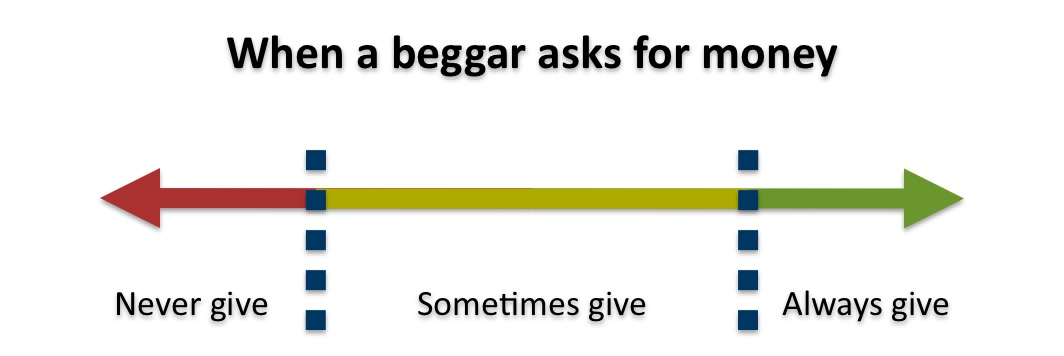
My view falls in the “Sometimes give” area. I want to be clear from the outset, lest people suspect my motives, that I am for helping the poor. (I’m not going to detail how I’ve done that in the past; people shouldn’t have to give a charity résumé before they’re allowed to talk on the subject. :-)) Like many people, I could describe various criteria, requirements, or caveats to use when deciding how to respond to a panhandler. I love these kinds of discussions, and I’m all ears when someone has stories, examples, or principles to share, because they help me choose my response more wisely.
While many have written plenty of insightful remarks on how to make that decision, I will not be discussing that. I want to limit my remarks to one specific idea: the misuse of King Benjamin’s words to support the “Always give” view.
Always Give
I have heard, more than once, a person express the very extreme view that the restored gospel requires us to always give money to a beggar when asked, regardless of the circumstances. One commenter insists that we must not ascertain motives at all:
I don’t think it’s up to us to judge people’s motivation[. The] only person who can judge that is God. If your motivation for giving is pure, regardless of what the person does with the money, you have done what you are suppose to do and hence have been pleasing to God. Let God be the judge of the beggar taking advantage of good natured people.1
Another person says that the source of this idea is King Benjamin:
Phil Pugsley, who is LDS, says he often feels ambivalent when he comes across a panhandler. For guidance, the retired lawyer turns to his scriptures, particularly a sermon by King Benjamin recorded in The Book of Mormon. “When we see people who ask us for help, we are not supposed to look into their motives,” says Pugsley. … He dropped $1 into Donald’s plastic mug.2
Another writer insists that King Benjamin clearly teaches that, as long as we have the money, we must give it when requested:
Ever since I first read the fourth chapter of Mosiah, I have always tried to give money to anybody asking for it. … King Benjamin’s message … seems very clear to me: we are expected to give to the poor personally. We are expected not to judge their circumstances but simply to give if asked. …
It seems to me, a clear understanding of the scriptures would indicate that if I am walking along 5th Avenue in New York and a panhandler asks me for some money, I am expected to give him some change. … Whether he uses that money wisely is his problem, not mine. My responsibility is to give to those who ask.4
In every case, the pattern seems to be that (1) we must not attempt to draw conclusions, even reasonable ones, about the person’s needs or intentions regarding the money, and that (2) if we have money, we are always morally obliged to give it.4 In other words, on the spectrum of possible responses above, in situations where the giver has money and could safely give it, the only option for a covenant-keeping believer in the restored gospel is to give the money to the asker. To do less would be to reject the Savior’s teachings.
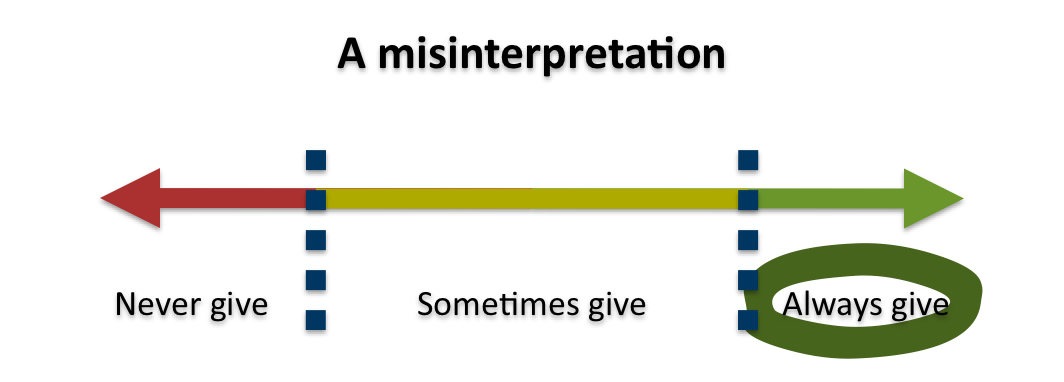
Both of these ideas are almost always attributed to King Benjamin’s sermon in Mosiah 4. I share these examples to demonstrate that this idea is alive and well, lest anyone accuse me of attacking a strawman.
Conclusion
I do not object if someone wants to hold themselves to a standard of always giving money whenever they are asked. They’re welcome to do that. What I do wince at is their citation of King Benjamin as teaching this idea, and their insistence that it is a standard that God holds all his people to. Neither is true.
Sometimes in discussions where King Benjamin is cited to support the “Always give” view, people rebut by quoting other scriptures or pointing out logical or practical problems with always giving. This is unfortunate, because it seems to pit one prophet against another, or a prophet’s words against man’s wisdom. This can make the “Sometimes give” view seem either contentious or unfaithful. It’s completely unnecessary, though, because the “Always give” view can be dealt with just by looking at King Benjamin’s words themselves.
King Benjamin was definitely critical of the “Never give” view, and he gave stern warnings to people who treated the poor … well, poorly. 🙂 But if you read his words carefully, it becomes apparent that he did not teach the “Always give” view either. To follow his prophetic counsel well, we have to first understand what he taught. I will try to clarify some of that in my next post.
Continued in What King Benjamin Actually Says.
Notes
Image credit: King Benjamin Addresses His People, by Gary L Kapp.
1. Comment by blewis, 27 Oct. 2009, on Kristen Moulton, “Can believers really pass by the beggar?,” Salt Lake Tribune, updated 23 Oct. 2009.
2. Kristen Moulton, “Can believers really pass by the beggar?,” Salt Lake Tribune, updated 23 Oct. 2009.
3. Geoff B., “Of Panhandlers, parking meters and King Benjamin,” MillennialStar.org, 7 Mar. 2007, accessed 4 Mar. 2010. I must add, though, that I really appreciated this author’s point that the Lord wants poverty relief to be done face-to-face, from one individual to another, rather than through large, impersonal programs.
4. Granted, the Millennial Star article specifies conditions that are “within reason”: that the giver actually have money on him, and that he not be endangering himself by giving it, such as in opening his wallet in a dark alley. But all of his conditions have to do with judging the giver’s circumstances; he forbids judging the asker’s circumstances. Thus, I feel that his view is an accurate example of the “Always give” view.
Nathan, great article. I think you looked at this in a new and interesting and philosophical way. I appreciate you reading my post at M*.
I think I pretty much agree with what you’re saying, Nathan.
I just want to add one thing. I think that the spirit of King Benjamin’s sermon is to ALWAYS notice the beggar and to feel for them. Thus, even if we do not always give, we should always be conscious about (a) there are very needy people in the world, (b) this person I’m walking past is certainly one of them, (c) even if I can’t trust them with my money, or I don’t have money, that doesn’t mean they don’t genuinely need it, and (d) the world is often cruel. We ought to feel pain whenever we see those in need. And we ought to not try to avoid those who are in need.
I think that many people are more concerned with alleviating their own guilt than they are with really appreciating that regardless of whether you can excuse yourself for not giving — people still need help. In Levinas’ terms, the other calls for us in an infinite way, whether we hear it or not.
Thanks, Geoff and Dennis.
Geoff, I’m glad you liked the article. I really didn’t want to come across as critical of anyone; I just wanted to find some quotes to use as a springboard into discussing the topic. My favorite part about your article was your point about the Lord wanting us to give face-to-face, to take part, in a way, in the asker’s life. I think that’s the same principle behind fast offerings. The Lord does not just want sterile monetary donations; he asks also that we go without for two meals. He wants us to take part in the asker’s life, and feel what he feels. It turns our donation into an offering.
Dennis, good to see you back! Heaven knows we haven’t posted much lately to give you a reason to come visit! 🙂 I totally agree with you. King Benjamin’s main points had much more to do with how we feel toward the beggar, with getting us to make his needs our needs. It just happens that in many cases, purifying our feelings involves giving money or support.
I also like your point, “Many people are more concerned with alleviating their own guilt.” In my past, after giving money, I’ve realized that that was my motivation—I hadn’t even asked myself what would actually help the beggar, only what would make me stop feeling guilty.
Nathan: In my past, after giving money, I’ve realized that that was my motivation—I hadn’t even asked myself what would actually help the beggar, only what would make me stop feeling guilty.
I can definitely say the same—honestly, my own personal weaknesses in this regard is why I thought of this problem in the first place.
This is a clear example of FUZZY logic. Never give / Always give are the extreme (0 and 1) of variable degree of “give AND not give” (0,1 – 0,9).
I can’t do it in English, but this could be an interesting article about “How to calculate when to give or not give using FUZZY logic”. If you want, you can help me to identify which “variables” are involved in this decision.
Fun idea. I figure, as with any decision, the variable that trumps all variables is ‘What the Spirit tells me.’ In the absence of specific instructions, though, other variables might include ‘The beggar’s genuine need,’ ‘My resources,’ and ‘Others who depend on me.’ Thoughts?
“What the Spirit tells me?” is not a variable, is a “result”! “What the Spirit told me?” is a variable.
Sometime we have to change our answer to same situation. Of course FUZZY logic is, as all other logic, a tool to prepare inspiration. Logic is worth to solve logic problems, and FUZZY logic is the more close to “human logic.”
I’ll add “our personal knowledge” of beggar. Our capacity to identify “need” or, better, symptoms of need. Dress, nationality, skin care, eye’s expression.
“What the Spirit tells me?†is not a variable is a “resultâ€! “What the Spirit told me?†is a variable.
I’m not sure I understand what you mean by this.
I’m also not sure you understood what I was saying about the Spirit being a variable. It’s probably my fault for not being clear. 🙂
What I mean is, when I am making a decision in life, such as whether to give to a panhandler, I’m required to use discernment and judge the situation. To do that, I’ll consider a lot of circumstances (his apparent need, my resources, my safety, etc.).
But no matter which course of action the circumstances seem to point me to (giving or not giving), if I receive a strong, clear impression from the Spirit that points me the other way, I should follow it. That’s what I mean by the Spirit being a variable. It’s one factor that I should consider, and it’s the most important factor.
Does that make sense? What do you think?
Sometime we have to change our answer to same situation. Of course FUZZY logic is, as all other logic, a tool to prepare inspiration.
I think we’re agreeing. The Spirit could prompt us differently in two situations that seem identical. And logic is a useful exercise that prepares us to feel the Spirit tell us whether we’ve arrived at the right conclusion. I think of it as the work required of us before Heavenly Father’s going to intervene with his wisdom, like when he says to “study it out in your mind” before you ask him (D&C 9:8).
We agree to all! Yes, we can consider “inspiration” as a bivalent variable and put a rule such:
For me, if first variable is true, no matter the others, I give.