
 Posted by
 Occasionally I have heard comments from people that reflect a misunderstanding of the Savior’s teachings about repentance and forgiveness. In a previous post (The Benefits of Sin?), I told how one person put it: “I think that sometimes it’s good that we sin, because of how we grow in the process of overcoming it.” This suggestion in effect says, “It is sometimes necessary for us to sin in order to learn certain lessons, such as about love and forgiveness.” Sometimes the parable of the two debtors is used as a proof text (Luke 7:40-43). In it, the Savior says that of two debtors who had their debts forgiven, the one who owed more felt more love toward the creditor. It’s easy to see how some might hear that parable and conclude, “Well, I guess the more I sin, the more I will love the Lord. So sinning is actually a good thing.”
In this post, I will explain some problematic implications of this mistaken notion. First, I want to dispel the misinterpretation of the parable of the two debtors.
The Prophets Weigh In
One quick way to see what modern prophets have to say about a scripture passage is to see how it has been used in general conference talks. This is made easier today by a great little site called scriptures.byu.edu. A quick search under Luke 7 yielded this commentary on the parable by Elder Marion D. Hanks, then of the first quorum of the Seventy: “There is here, of course, no encouragement or condoning of sin.”((Marion D. Hanks, “He Means Me,” Ensign, May 1979, p. 74.))
Paul the apostle made the same clarification. In Romans 6, he makes an ironic suggestion and then immediately negates it: “What shall we say then? Shall we continue in sin, that grace may abound? God forbid” (Rom. 6:1-2).
In other words, whatever deep truths the Savior was teaching with the parable of the two debtors, we know for sure one thing he was definitely not teaching. He did not intend us to think that sinning was beneficial or even harmless because it led us to be more loving, or wiser, or stronger.
Since we have ruled out what the parable of the two debtors does not mean, you may be expecting me to explain what it does mean. Well, I imagine it has more to do with gratitude for our undeserved forgiveness and empathy toward fellow sinners, but if you really want to know, you might explore it during your personal gospel study (you might even use the BYU website I mentioned above). However, my main purpose is not to interpret the particular parable I’ve mentioned, but rather to elaborate on the particular doctrinal misunderstanding it highlights. Paul and Elder Hanks make it clear that sin is not good or necessary, and I want to explore further why that is.
Growing in Light and Truth
In a CES Fireside two years ago, Elder Merrell J. Bateman displayed a chart that compared the path of obedience to the path of sin and repentance.((Merrill J. Bateman, Look Forward with an Eye of Faith (CES fireside, 5 Mar. 2006, BYU), p. 6.)) He labeled the vertical axis “Light and Truth” (other names for this axis could be growth, progress, or maybe eternal joy). He designated the horizontal axis as time. I have recreated and simplified his chart below.
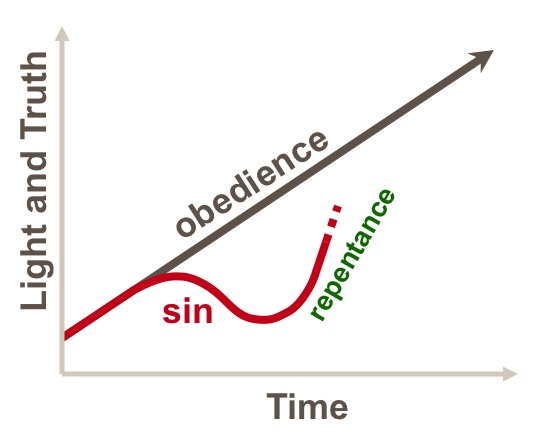 |
| Obedience versus Repentance. Sin definitely interrupts the steady growth that comes with obedience, but where exactly does repentance lead to? |
Elder Bateman drew a rising line to show how obedience to the laws of God helps us progress over time. This path outlined by Heavenly Father is the only way to achieve a perfect, lasting fulness of joy and eternal fulfillment. “There is none other salvation save this which hath been spoken of; neither are there any conditions whereby man can be saved” (Mosiah 4:8). And of course, the straight, rising line represents Jesus Christ’s perfect life of uninterrupted progress, because only he has ever adhered to the will of God without exception.
Elder Bateman then drew a second line that dips, to show how sin prevents our progress, and then rises again, to show how repentance restores our progress. This line represents every one of us, “for all have sinned, and come short of the glory of God” (Rom. 3:23).
Elder Bateman does not show where this dipping-rising line ends; it fades into a dotted line. I imagine that he didn’t complete the line because he wanted to stay focused on his topic, which went in a different direction. But let’s think about how the rest of that sin-repentance line should be drawn. (And of course, there are limitations whenever we try to quantify eternal realities in mathematical ways. But if Elder Bateman felt like some important insights could be drawn out of this little exercise, I feel OK about taking it a few steps further, with that caveat in place.)
A Better Way than Jesus Christ?
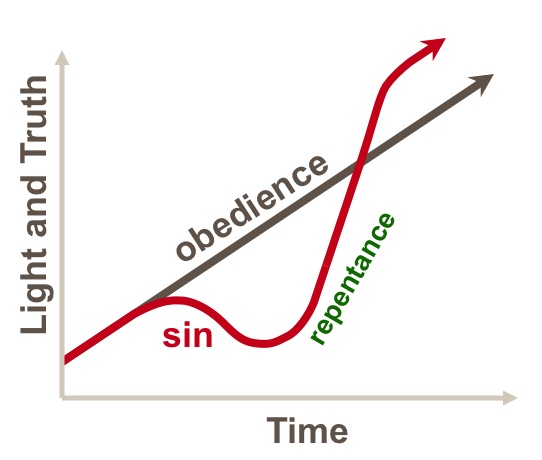 |
| False Notion 1. Some mistakenly conclude that we are better off for having sinned and repented, because it seems we learn and grow in ways we could not have done otherwise. |
If we say that sinning leads us to qualities and virtues, such as wisdom or kindness, that we could not have otherwise obtained, we are in effect drawing the sin-repentance line to end at a higher level than the obedience line. We are saying that sin led us to a higher level of understanding and goodness than obedience would have. In fact, we are saying that sin is not only beneficial, it is necessary, because without it, we simply could not gain certain wisdom or attributes.
There are some serious problems with this position. If we really believe this, we are in effect saying, “I am privy to certain knowledge that Jesus Christ does not have. Because he was perfectly obedient, he does not have access to some of the wisdom and characteristics that I have attained. I am wiser than him. I am better off than him.”
Perhaps that is why the prophets are so diligent about making such clarifications as this one: “The idea that one can deliberately sin and easily repent or that one is better off after sinning and repenting are devilish lies of the adversary.”((Dallin H. Oaks, “Sins, Crimes, and Atonement,” address to CES religious educators, 7 Feb. 1992, Temple Square Assembly Hall, text at ldsces.org.))
Conclusion
It’s easy to see how attractive this notion is, because we learn so much through repentance. Experience seems like the best teacher, based on our … well, experience. But if we take seriously all the warnings and prohibitions against sin, we must recognize that nothing is to be gained by sinning.
We now have two unsettled questions. First, how do we become more like our all-knowing Father in Heaven if we are never supposed to have certain experiences? Second, how should we finish Elder Bateman’s chart? Where does the sin-repentance line end? I will address these questions in following posts.
Of course, the whole mess is easily avoided when you realize that self righteousness is itself a sin requiring repentance. It’s much better to have never been, but alas, Church remains full of the fallen. Thanks be to God for repentance.
Consider the following: mere “obedience” out of habit (meaning that it’s not out of a heartfelt need to live the gospel) is only a little better than not obeying at all. Thus repentance and forgiveness might lead somebody to a higher level of goodness and obedience than before, as they’ve seen the wages of sin and no longer have a desire to be bound by them, plus they’re learning how to be good people from the heart (and is there any way other than to repent) rather than just through not doing anything really wrong.
I see what you’re saying, Clumpy. And kind of like you said, in my own experience, I have found myself appreciating the atonement and the commandments, after passing through repentance, more than I did before.
The question is, was it possible for me to arrive at that greater appreciation some other way? Could I have come to that same appreciation without violating God’s commandments?
The graph assumes that obedience can increase/decrease. How could one be “more obedient” about something (I suppose one could pay more than a full tithe, but it’s just marked down as “full tithe”)? Graphing it out is fun/interesting, but I think it ultimately reduces sin and obedience to quantitative measures, which are unrealistic. And re: Nathan’s comment, does appreciating the atonement more make one more obedient, or just more thankful?
Whistler,
I agree that you can’t quantify obedience. You make some good points. I suspect that at any given time, we are living truthfully or living falsely to our obligations, and you are right that it can’t be measurably quantified. I believe that Nathan’s chart doesn’t depict variable obedience, but rather variable light and knowledge. We grow in light and knowledge when we are true to our covenants and obligations, and we lose light and knowledge when we are false to them. (Living false to our obligations may even mean obeying the commandments, but with a false heart)
In other words, wether you believe obedience is “either/or” or a “spectrum” or any other arrangement, as long as you believe that light and knowledge decreases in the absence of obedience, the chart seems to work quite well.
Whistler: Graphing it out is fun/interesting, but I think it ultimately reduces sin and obedience to quantitative measures, which are unrealistic.
So true. That’s why I included the caveat, “There are limitations whenever we try to quantify eternal realities.” All metaphors have limits, including the parables of the Savior himself. Any metaphor can seem absurd if we take it beyond its intended scope. I think Elder Bateman intended to show the negative effects of sin, and chose to represent that through a graph in which a line dips, just as the Savior represented sin through a plant that withers.
Does appreciating the atonement more make one more obedient, or just more thankful?
That’s a great question. I’d have to think about it. Why do you ask?
Clumpy: Mere “obedience†out of habit (meaning that it’s not out of a heartfelt need to live the gospel) is only a little better than not obeying at all.
One last thing: Clumpy makes a good point when he puts “obedience” in quotes. I think I should clarify that when I say obedience, I don’t mean just external actions. I’m trying to use obedience in the same way the scriptures use it, which includes obligations of the heart, choosing the right attitude, actively practicing virtues like humility, not giving gifts grudgingly, etc. The Savior wasn’t able to perform his sinless sacrifice just because he always visited his home teachees. The word obedience means more than that; we just don’t always talk about it that way. Sorry if I didn’t make that clear.
Nathan,
You really should put captions under your graphs. If someone were to skim your article and see the graphs, they may conclude that you are saying the opposite. You should put a caption or title such as “Fallacy” on the second graph, and something like “How repentance truly works” for the first. It will prevent misunderstanding.
Great idea. Anyone out there know the HTML code for a caption below the image?
Nevermind, I figured out how to jerry-rig it. How does that look?
I like it, Nathan. Good job!
Keep in mind that I enjoy playing devil’s advocate and may not always be making a direct point. I’m not pointing out flaws so much as testing theories.
Right on, I suspected as much. 🙂 It does make me articulate things more thoroughly.